
Your Pages Not Showing
in Google? We Fix That.
Expert SEO consultancy for indexing issues. We diagnose and resolve technical, content and canonicalisation problems preventing your pages from being indexed in Google, Bing and AI search.
Trusted By Leading Brands
We've helped hundreds of businesses resolve indexing issues and achieve sustainable organic growth.





Get Expert Indexing Issue Support
Choose Your Consulting Package
Flexible SEO consulting focused on diagnosing and fixing your indexing issues. All packages provide the same expert support.
Single Hour Consultation
£200/hour
- 1 hour of expert indexing support
- Real-time support via your preferred platform
- GSC status diagnosis & action plan
- Robots.txt & noindex review
- Crawl budget assessment
- Emergency issue resolution
5-Hour Package
£180/hour
- 5 hours of expert indexing support
- 10% discount on hourly rate
- Full indexing audit & root cause analysis
- GSC Page Indexing report deep-dive
- Crawl log analysis
- Implementation support
- Canonical & canonicalisation review
- Multi-platform communication
10-Hour Package
£150/hour
- 10 hours of expert indexing support
- 25% discount on hourly rate
- Comprehensive technical & content audit
- Full GSC status breakdown & fixes
- JavaScript rendering assessment
- Sitemap & redirect audit
- Bing & AI search indexing review
- Priority emergency support
All packages cover the same comprehensive indexing support. Bulk packages offer better rates for complex, large-scale indexing audits.
If It's Not Indexed, It Can't Rank
Indexing issues are one of the most common and most damaging SEO problems a website can face. Without indexed pages, there is no organic visibility, no rankings and no search traffic. Most websites have a degree of indexing issues, although many are unaware of the extent to which Google may be ignoring or dropping their content.
It does not matter how strong your content is or how much you have invested in your website — if search engines cannot or will not index your URLs, none of that investment delivers a return. Google has become much stricter about the kind of content it's prepared to index, making it harder for SEOs and webmasters.
We provide specialist page indexing SEO consultancy to diagnose, prioritise and resolve indexing issues across websites of all sizes — from a handful of URLs stuck in “Discovered, currently not indexed” to thousands of pages with cascading technical failures.
What Types of Indexing Issues Do We Solve?
Indexing problems rarely have a single root cause. We work across all categories of indexing issue.
Technical SEO Indexing Issues
- Robots.txt directives blocking crawlers from key pages
- Noindex tags applied unintentionally via CMS or deployment
- 5xx server errors & timeouts preventing Googlebot crawls
- JavaScript rendering failures hiding content from crawlers
- Crawl budget waste on low-value URLs
- Redirect chains, loops and orphaned pages
Content Quality Indexing Issues
- Thin, duplicate or near-duplicate content excluded by Google
- Auto-generated or boilerplate content diluting quality signals
- E-E-A-T signal weaknesses suppressing domain-wide indexing
- Pages failing to satisfy user intent for target queries
- Templated content patterns reducing indexing rates
- Content at scale that drags down overall domain quality
Canonicalisation & Duplication Issues
- Missing or contradictory canonical tags across URL variants
- Keyword cannibalisation causing Google to drop competing pages
- HTTP/HTTPS, www/non-www, trailing slash URL inconsistencies
- Parameter URL duplication wasting crawl budget
- Hreflang errors causing international indexing confusion
- Google overriding your canonical choice with a different URL
URLs Not Getting Indexed
- New content stuck in 'Discovered, currently not indexed'
- Pages crawled but never added to the index
- Crawl budget allocation preventing priority page crawls
- Internal link equity not reaching important pages
- Domain-level quality signals suppressing new content indexing
- Systematic diagnosis and action planning to resolve blockages
Common Indexing Issues: A Complete Breakdown
Understanding the full landscape of indexing issues is essential for diagnosing what is happening on your site.
Robots.txt Blocking Critical Pages
A misconfigured robots.txt file can prevent search engines from crawling entire sections of your site — especially common after migrations or CMS updates where staging disallow rules are never removed.
Noindex Directives Applied in Error
Noindex tags silently remove pages from the index. Common causes include CMS defaults, theme file logic errors, and plugins injecting noindex without the site owner's knowledge.
Server Errors & Availability Issues
5xx server errors, connection timeouts and DNS failures prevent indexing. Intermittent errors are particularly damaging as they may not be visible during manual browsing.
JavaScript Rendering Problems
Content rendered via client-side JavaScript (React, Angular, Vue, Next.js) may not be indexed if rendering fails or times out. Server-side or hybrid rendering resolves this.
Crawl Budget Waste
Parameter URLs, faceted navigation, session IDs and internal search pages drain crawl budget away from pages that matter — causing important pages to go unindexed for weeks.
Orphaned Pages
Pages not linked to from anywhere on your site are invisible to link-following crawlers. Even sitemap-listed orphans are treated as low priority without internal link support.
Redirect Issues
Redirect chains, loops and incorrect 302/301 usage all create indexing problems. Googlebot may abandon chains longer than 3 hops entirely, leaving destination URLs unindexed.
XML Sitemap Issues
Sitemaps containing noindexed, redirected or 404 URLs send conflicting signals to Google. Sitemaps must be accurate, current maps of only the URLs you want indexed.
Duplicate Content Without Canonical Signals
Same content at multiple URLs with no canonical tag forces Google to decide which version to index — often choosing the wrong one or indexing none of the variants.
Hreflang & International Targeting Errors
Missing return tags, invalid language codes or broken hreflang references cause Google to fail to index regional variants correctly, harming your international visibility.
Poor Site Architecture & Internal Linking
Pages requiring 6+ clicks from the homepage are far less likely to be crawled frequently. A flat, well-linked architecture ensures full crawl coverage of all important pages.
Security & Access Restrictions
Pages returning 401 or 403 to Googlebot will not be indexed. WAF rules and rate limiting can inadvertently block crawlers — server log analysis identifies these patterns.
How We Diagnose & Resolve Indexing Issues
A methodical, data-driven approach — not guesswork or generic fixes
Comprehensive Indexing Audit
Full audit of indexing status across GSC, Bing Webmaster Tools and server log data — identifying every indexed and non-indexed URL with root causes.
Prioritised Action Plan
We categorise every issue by impact on organic visibility and revenue. You get a clear plan that fixes the highest-impact problems first — not a list of every minor issue.
Implementation Support
We work with your dev team or CMS contacts to implement fixes directly. Every fix is verified post-implementation to confirm the intended indexing effect.
Ongoing Monitoring
We provide continuous monitoring of your indexing status with alerts for new server errors, indexed page count changes, and GSC status distribution shifts.
500+
Indexing Issues Resolved
100%
Client Satisfaction
48hr
Audit Turnaround
All
Search Engines Covered
Google Search Console: Page Indexing Status Explained
Every status reason in the GSC Page Indexing report — what it means and how we fix it.
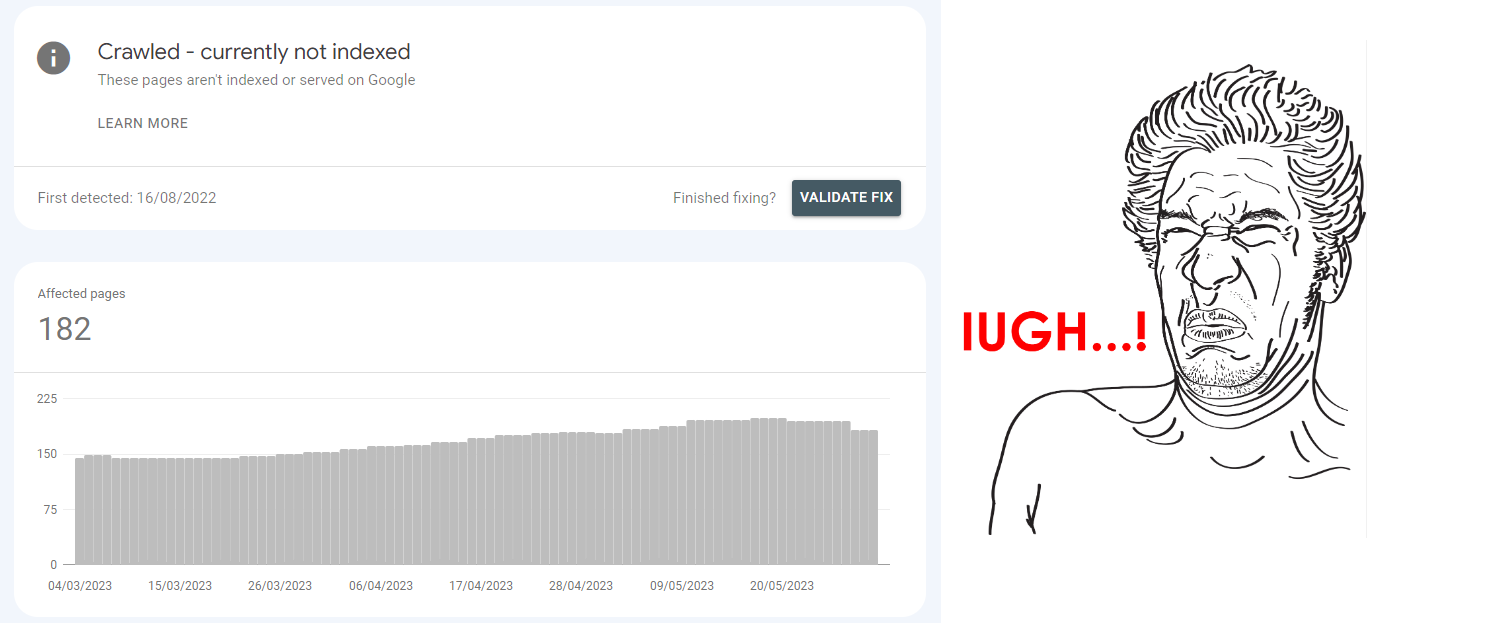
Crawled, Currently Not Indexed
CriticalGoogle crawled the page but chose not to include it. Typically indicates a content quality issue. We audit against quality benchmarks, assess depth and uniqueness, and improve or consolidate content to meet Google's indexing threshold.
Discovered, Currently Not Indexed
High PriorityGoogle knows the URL exists but hasn't crawled it yet — a crawl prioritisation issue. We improve internal linking, fix sitemap accuracy, reduce crawl waste, and request indexing for critical pages.
URL Marked 'noindex'
CriticalA noindex directive is present and being respected. We verify whether this is intentional or an error — CMS migrations, theme changes and plugin updates are common culprits for accidental noindex.
Blocked by robots.txt
CriticalA robots.txt directive is preventing Googlebot from crawling the page. Google may still know the page exists from external links but can't assess the content for indexing.
Soft 404
High PriorityThe page returns 200 but Google classifies it as having no meaningful content. Common on ecommerce sites with out-of-stock templates or search pages with zero results.
Server Error (5xx)
High PriorityGooglebot encountered a server error. If persistent, Google will drop the URL from the index. We correlate server logs with GSC crawl stats to identify the root cause.
Duplicate, Google Chose Different Canonical Than User
High PriorityGoogle is overriding your canonical signal — indicating a disagreement. We align all signals (internal links, sitemaps, redirects, canonicals) to consistently point to your preferred URL.
Duplicate Without User-Selected Canonical
InvestigateGoogle found duplicate content with no canonical tag specified and made its own decision about which URL to index. We implement explicit canonical tags to take back control.
Not Found (404)
InvestigateThe URL returns a 404. Expected for removed content, but problematic if pages that should exist are returning 404s or if large numbers of 404s from internal links are wasting crawl budget.
Blocked Due to Access Forbidden (403)
InvestigateThe server is refusing Googlebot's request. Often caused by WAF rules, rate limiting or server-side ACLs that inadvertently block search engine crawlers.
Blocked Due to Unauthorised Request (401)
InvestigateContent requires authentication and Googlebot receives a 401. Content behind authentication won't be indexed without implementing strategies like flexible sampling or metered access.
Alternate Page with Proper Canonical Tag
ExpectedThis URL points to another URL as canonical, and Google has accepted it. This is correct behaviour for URL variations. It only becomes a problem if the canonical target is wrong.
Page with Redirect
ExpectedThe URL redirects elsewhere and Google will index the destination. Normal for intentionally redirected URLs. Investigate if redirect chains are losing Googlebot along the way.
Blocked by Page Removal Tool
InvestigateTemporarily removed via GSC's URL Removal Tool (lasts ~6 months). Ensure the underlying issue is permanently resolved before the temporary removal expires.
Blocked Due to Other 4xx Issue
InvestigateA 4xx status code other than 401, 403 or 404 is being returned — such as 410 Gone or 429 Too Many Requests. We diagnose the specific code and implement the appropriate resolution.
Beyond Google: Bing & AI Search Indexing
Ignoring Bing and the growing AI search ecosystem is a strategic mistake. Bing powers not only its own search results but also Bing Copilot, ChatGPT's browsing capability, and numerous AI-powered search experiences.
Bing Webmaster Tools Indexing
Bing has stricter crawl budget limits for smaller sites, different JavaScript rendering handling, and separate robots.txt interpretation. We audit Bing indexing alongside Google to ensure full coverage.
AI Search Visibility
Google AI Overviews, Bing Copilot, Perplexity and other LLM-based tools rely on crawled and indexed content to generate responses. If your content isn't indexed, it can't be cited in AI search results.
Multi-Crawler Optimisation
Technical barriers affect different crawlers differently. We ensure your implementation works correctly for Googlebot, Bingbot and AI crawlers simultaneously.
Indexing Issues Resolved. Clients Satisfied.
Hear from businesses who restored their organic visibility through our indexing support.
Rachel T.
Marketing Director · London
“Our site had thousands of pages sitting in 'Discovered, currently not indexed' for months. Daniel identified the crawl budget waste within hours and we had a fix plan the same day. Indexed count doubled in 6 weeks.”
Marcus W.
Head of Growth · Manchester
“We had a noindex tag silently applied to our entire blog after a CMS migration. Completely missed by our team and two agencies before. Found and fixed within the first consulting hour.”
Sophie L.
Technical SEO Lead · Edinburgh
“The GSC status breakdown was the most thorough I've seen. We had a canonical override issue that had been causing Google to index the wrong pages for over a year. The fix was clean and fast.”
Tom H.
Technical SEO Specialist · Berlin
“JavaScript rendering was preventing our product pages from being indexed entirely. The Loom walkthrough explaining exactly what Googlebot was seeing made it easy to brief the dev team.”
Elena K.
eCommerce Manager · Dublin
“Soft 404 issues across hundreds of out-of-stock product pages were dragging down our entire indexing rate. The systematic fix approach and priority ordering saved months of cleanup work.”
David M.
CTO · Singapore
“Our Bing indexing was a complete afterthought until the audit revealed we were missing 40% of the pages indexed in Google. With AI search growing, that gap was costing us significantly.”
What Indexing Support Is Available For
One-off audits, emergency support or ongoing indexing monitoring — we cover it all
One-Off Indexing Audit
A standalone audit of your site's complete indexing status with a prioritised remediation plan.
Emergency Indexing Support
Rapid response for sudden indexing drops, algorithm impacts or site-wide deindexation events.
Post-Migration Indexing Review
Verify indexing health after domain changes, platform migrations or major site restructures.
GSC Status Deep-Dive
Systematic analysis of every non-indexed URL category in your Page Indexing report with specific fixes.
Crawl Budget Optimisation
Log file analysis to identify budget waste and implement controls that redirect crawling to priority pages.
Ongoing Indexing Monitoring
Continuous monitoring with alerts for new indexing issues before they compound into larger problems.
What are Google page indexing issues?
Before a page can appear in Google's search results, it has to clear three separate stages:
Crawl — Googlebot finds the URL and requests it.
Index — Google processes the page, decides it’s worth storing, and adds it to the index.
Rank — When someone searches, Google decides where (and whether) the page appears.
A “page indexing issue” is typically anything that stops a page going through stage two. The page might be crawled but never stored. It might be discovered but never crawled. It might be blocked, duplicated, redirected, or judged not worth indexing at all.
Google decides what to index as content is found on the web; if a piece of content is thin, low quality or doesn't meet a wide array of “quality” criteria it's likely to end up not being indexed and appearing in your “non-indexed reasons” in Search Console.
Google page indexing issues are rife — moreso now with the advent of AI and programmatic content strategies. Google simply has no reason to index what already exists on the web, which is why more and more website owners, webmasters and SEOs are seeing Google either de-indexing content or refusing to index new content.
Subsequently, Google page indexing issues are related to discoverability, crawlability and indexability — this covers things like technical SEO, content quality, compliance, links, spam and more.
Why indexing issues are a problem
Page indexing issues are a problem in a number of ways. Typically, Google not indexing pages is either because it doesn't want to (a quality or value issue) or because it can't (a technical SEO issue). Either way, they can have a profound impact on organic performance:
- Indexing issues can result in an abrupt loss of rankings, traffic and revenue.
- Indexing issues can impact a website’s overall perceived quality.
- Indexing issues can lead to wasted spend — investing in SEO and content where the benefits are less likely to materialise.
Thin pages or low-value pages at scale waste link equity and can impact broader domain performance in search, whilst more specific indexing issues can lead to an abrupt loss in rankings. Typically, indexing issues:
- Cost businesses important visibility
- Cost businesses money
- Lead to wasted spend and campaign spend bleed
- Reduce brand visibility and awareness
- Can lead to other quality and trust issues
- Can impact organic performance for pages that are performing
In short, page indexing issues are generally worth sorting out before they do more harm than good. What can start as a benign, low-level de-indexation of a few pages can quickly cascade, leading to much wider SEO issues — from disappearing rankings through to cannibalisation problems.
How indexing issues hit rankings, traffic and revenue
The damage from page indexing issues compounds, and it does so quietly.
Rankings
Unindexed pages hold no ranking positions, so they capture none of the clicks they were built to gain. Worse still, if the pages that are indexed are thin duplicates or the wrong versions, Google may be ranking pages you didn't intend — diluting the authority of the ones that matter.
Traffic
Every important page sitting in “Crawled – currently not indexed” or “Discovered – currently not indexed” is a page receiving zero organic visits. For a content site or blog, that's articles earning nothing. For an e-commerce site, it can be entire product or category pages missing from search.
Revenue
This is where it impacts most. Unindexed money pages — services, products, locations — are demand you've created but can't capture. And because the issue is invisible unless you go looking, the lost revenue accrues month after month while the rest of the marketing budget keeps spending against a loss-leading funnel.
The longer an indexing issue goes unidentified, the more it costs — and the more it can signal to Google that a wider section of the site isn't worth crawling. If you're not sure how much of your site is actually indexed, that's the first thing worth measuring.
Common signs of indexing issues
There are lots of giveaways for indexing issues, some of the most common being:
- Randomly disappearing results in search — if you google your target keywords and one minute your brand appears and the next it’s gone, that can indicate an underlying indexing issue.
- The wrong pages being served for queries or keywords — pages competing against one another (cannibalisation) can cause unstable positions or underperformance alongside indexing issues.
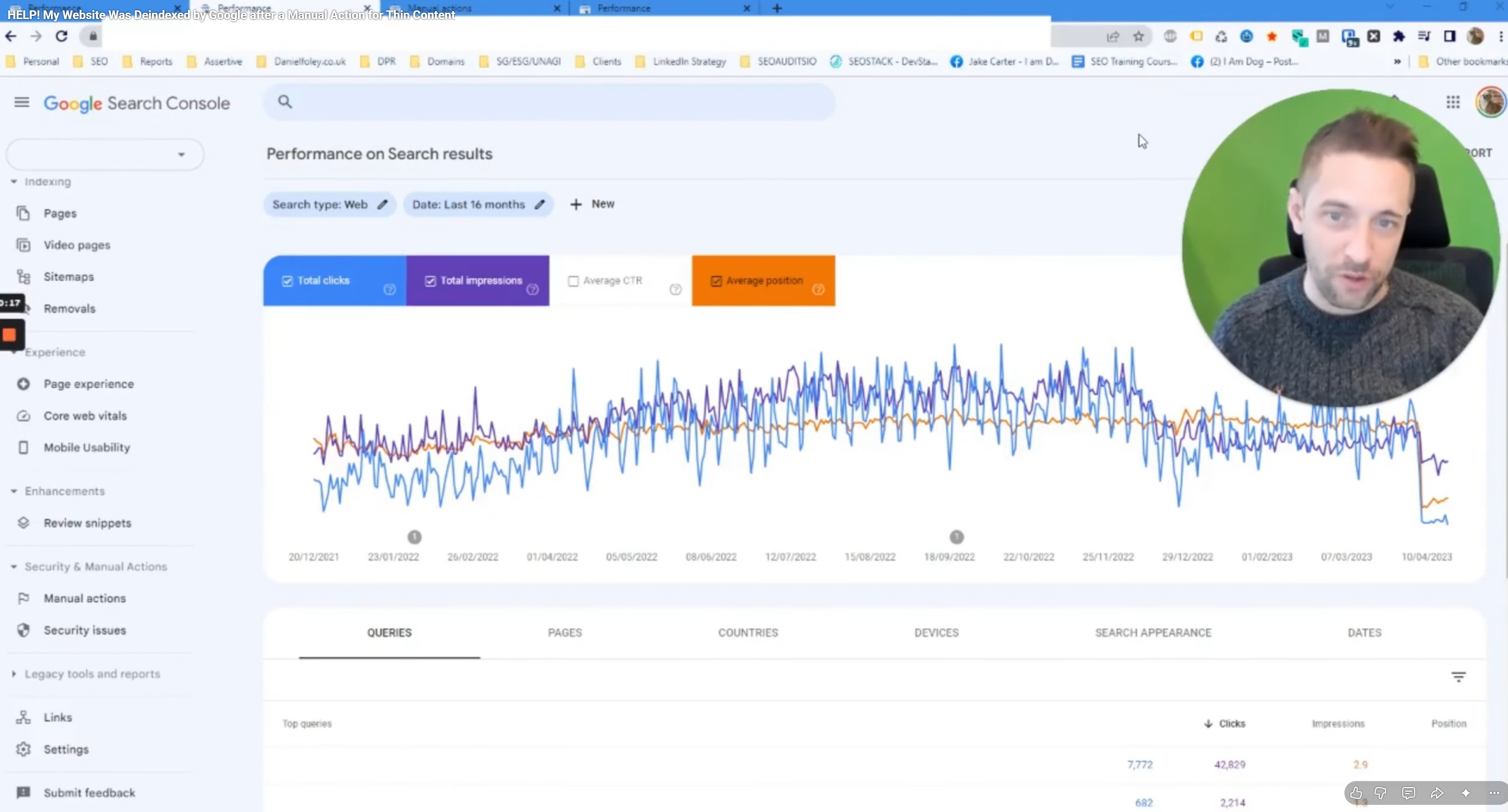
- Sudden or abrupt drops in impressions and clicks in Google Search Console — if indexing issues are present, key traffic-generating pages or page groups may be dropping from search, leading to a sudden change in performance.
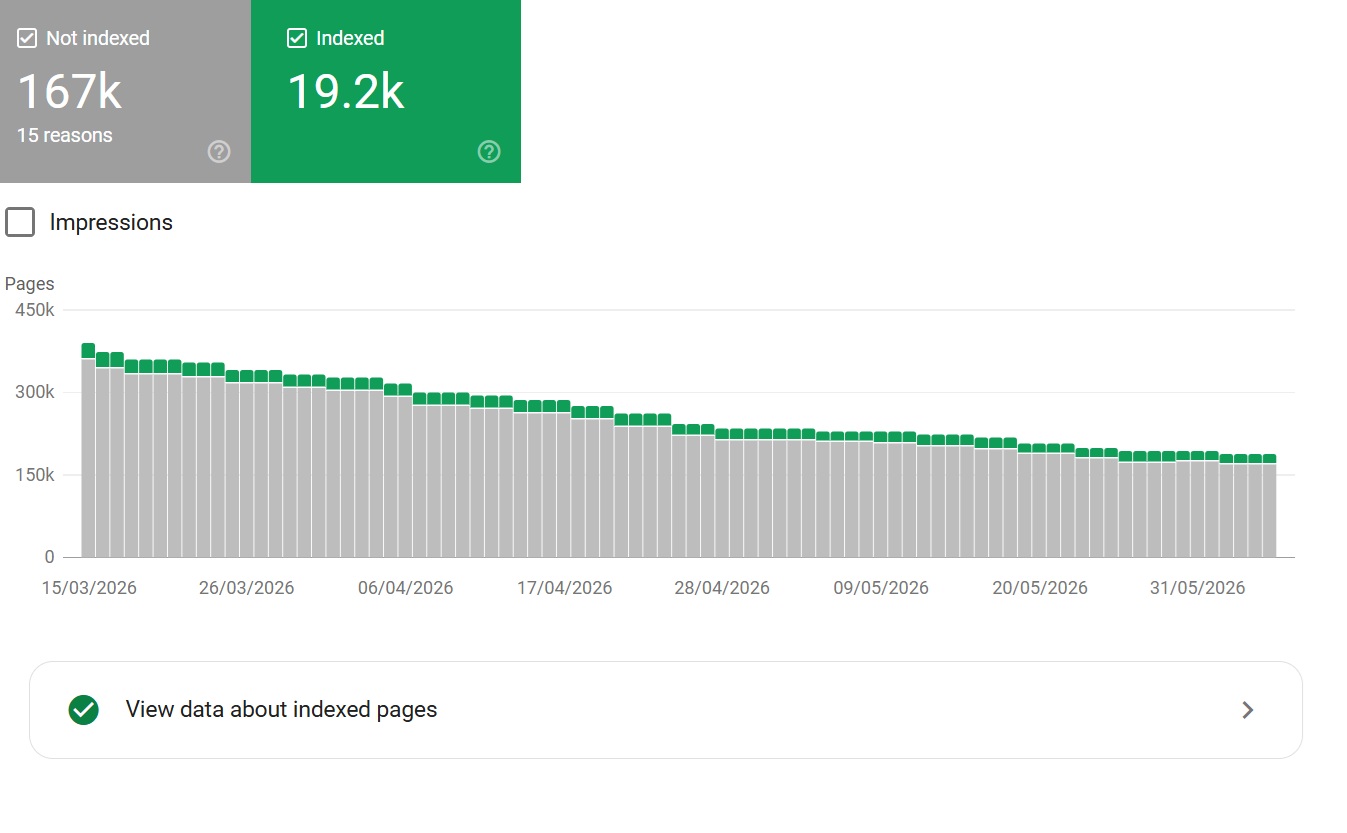
- A sudden change in the number of reported indexed or non-indexed URLs in Google Search Console.
Why indexing issues happen in the first place
Behind those Search Console statuses, the root causes tend to be a handful of recurring culprits:
Quality and value
Google indexes selectively, moreso now than in the past. Thin, templated, near-duplicate or low-effort pages increasingly don’t make the cut — and a site that produces a lot of them can find Google less willing to index the good pages too.
Duplication and parameters
Faceted navigation, filters, sort parameters, session IDs and tracking URLs can create endless near-identical pages. Google consolidates or ignores them, but they can also lead to canonical issues down the line.
Crawl budget
On large sites, Google won’t crawl everything. If crawlable URLs vastly outnumber what Google is willing to fetch, important pages can sit in “Discovered” indefinitely, and regularly-updated pages may be recrawled less often.
Technical configuration
A stray noindex, a robots.txt rule blocking the wrong path, broken canonicals, redirect chains, or a misconfigured CMS can deindex pages at scale and silently.
Site architecture and internal linking
Pages buried deep, orphaned, or only reachable from the sitemap signal low importance. This becomes more prevalent on larger sites.
JavaScript rendering
If key content or links only appear after JS execution, Google may not see them — leading to “crawled, not indexed” or pages indexed without their real content. Common with CSR (client-side rendered) websites or React SPA shells.
A new or low-authority site
New sites get crawled cautiously and indexed slowly. Months of “Discovered – currently not indexed” on a young site is common — and only partly a patience problem.
Deindexing after algorithm updates
Core and spam updates can remove pages judged low-quality. A growing “Crawled – currently not indexed” count with no new pages added is a warning sign.
How we can help you resolve your Google page indexing issues
We offer a comprehensive SEO auditing service where we can specifically audit your website's index health. We typically evaluate what is crawlable and indexable, and then we check to see what is and isn't indexed.
From there we work backwards — checking tags, indexability, internal links, content quality, what Googlebot sees on render and more. Typically we help clients to:
- Restore good indexing health
- De-clutter and prioritise content for indexing
- Remove or block non-value content
- Improve internal link equity distribution
- Restore lost rankings and help with ranking instability or volatility
- Address cannibalisation issues
- Clean up non-indexed page reasons in Google Search Console
…and more. Whatever your indexing issues may be, get in touch to see how we can help fix your indexing issues today.
Get Expert Help With Your Indexing Issues
If your pages are not being indexed, you are leaving organic traffic and revenue on the table. Whether you are dealing with a specific GSC status issue, a site-wide indexing decline, or want a professional audit of your indexing health — we can help.
We work with businesses globally across all industries and website platforms. Our indexing consultancy is available as a one-off audit, as part of an ongoing SEO retainer, or as targeted support for specific issues that need immediate attention.
Book Your Indexing Support Session
Add a consulting slot to your cart, check out, and we'll reach out to schedule your session and start resolving your indexing issues.